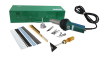
Plastic Welding Extruder: Applications and How to Choose the Right One
What is a Plastic Welding Extruder?
A plastic welding extruder is a machine that melts plastic welding rod and extrudes it into the joint to bond materials together. It is ideal for applications requiring high strength, especially with thermoplastics such as PE and PP.
Its key advantage is the ability to add material into the joint, similar to metal welding, resulting in strong and durable welds.
What Applications Is It Used For?
Extruder welders are commonly used in structural and thick-material applications, such as:
- Chemical tanks
- Wastewater and geomembrane structures
- Large HDPE piping
- Repair of thick plastic components
- Industrial applications (e.g., chemical plants)
Extruder vs Hot Air Welding
| Feature | Extruder | Hot Air |
| Application | Thick / structural work | Thin / sheet work |
| Strength | Very high | Moderate |
| Speed | Fast for large jobs | Fast for detail work |
| Difficulty | Higher | Easier |
For flooring or thin membranes, Hot Air is more suitable
For tanks or structural work, Extruder is the better choice
Advantages of Extruder Welding
- Suitable for thick materials (10–30 mm and above)
- High weld strength
- Ability to add filler material
- Ideal for heavy-duty industrial use
Limitations to Consider
- Requires operator skill
- Heavier equipment
- Surface preparation is essential
- High operating temperatures require safety precautions
How to Choose a Plastic Welding Extruder
Consider the following factors:
1. Output Capacity
Small jobs: ~1–2 kg/hr
Large jobs: 3 kg/hr and above
2. Material Compatibility
PE / HDPE
PP
PVC
PVDF
3. Application Size
Thick materials → higher output required
Small jobs → portable units are sufficient
4. Machine Weight
On-site work → lighter machines preferred
Workshop use → larger machines acceptable
5. Brand and Service Support
Availability of spare parts
Local service support
Required Accessories
- Welding Rod
- Surface Preparation Tools
- Welding Shoe
Basic Welding Process
- Prepare and clean the surface (roughen if needed)
- Preheat the material and welding shoe
- Extrude material into the joint
- Apply pressure using the welding shoe
- Allow to cool
Weak bonding
→ Insufficient temperature or poor preheating
Cracking welds
→ Cooling too quickly
Porosity (air bubbles)
→ Poor surface preparation
Burn marks
→ Excessive temperature
FAQ
Q: Can it weld PVC?
A: Only if the machine supports it, and temperature must be carefully controlled.
Q: Is external hot air preheating required?
A: Not necessarily. Most extruders have a built-in hot air system for preheating, which is sufficient for general use. However, in very cold environments, additional hot air may improve weld quality.
Q: Is it suitable for beginners?
A: Yes, especially models with digital displays that allow precise temperature control. However, basic training is recommended to achieve consistent weld quality.
Q: Is welding pipes, sheets, and membranes different?
A: The principle is the same. A single extruder can be used for all applications by selecting the appropriate welding shoe for the job.
Common types of welding shoes:
Overlap Shoe (Flat Shoe)
For sheet welding and flat surfaces
Fillet Shoe
For 90° joints such as tanks and structures
Corner Shoe
For internal and external corners
V-Seam Shoe
For pre-grooved V-joints, allowing deeper and stronger welds
Round Shoe
For pipes and curved surfaces
Conclusion
Plastic welding extruders are essential tools for high-strength plastic welding, especially in structural and HDPE applications. Choosing the right machine ensures better weld quality, higher efficiency, and long-term reliability.