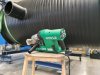
Two Popular Techniques in Plastic Welding: Pendulum Welding & Draw Welding
Understand the Difference Choose the Right Technique for the Job with the BAK RiOn
Two Popular Hand-Welding Techniques You Should Know
When it comes to plastic welding with a hot air tool, professional technicians rely on two main techniques:
Pendulum Welding and Draw Welding.
Both methods use heat to fuse a welding rod into the base material, but they differ in movement, temperature requirements, and the resulting weld appearance, strength, and working speed.
Pendulum Welding The Classic Swing Technique (Swing Movement)
Pendulum Welding is the most universal hand-welding method and works with almost all common thermoplastics, especially PVC, ABS, PP, and PE.
The operator swings the hot air nozzle gently back and forth over the seam while feeding the welding rod by hand.
Quick Steps
- Set temperature based on the material:
- PVC 280320°C, PP/PE 300-350°C
- Use a slot nozzle for precise heat control
- Swing the nozzle evenly across the seam while feeding the rod
- Maintain a steady rhythm to avoid burning the material
Strengths
- Excellent heat control and precision
- Ideal for curves, corners, and confined areas
- Compatible with PVC, which cannot tolerate excessive heat
Limitations
- Slower than Draw Welding
- Requires steady hand control and consistent rhythm
Draw Welding Continuous Push/Draw Technique (Push / Draw Movement)
Also known as Speed Welding, this method is designed for high-temperature-resistant materials like PP and PE.
The operator attaches a Speed Welding Nozzle to the hot air tool. The welding rod is fed through the nozzle, and the tool is pulled forward in a continuous motion. The rod melts and settles into the seam automatically.
Quick Steps
- Use a Speed Nozzle Ø4Ø5 mm
- Set temperature to 300350°C
- Feed the welding rod directly through the nozzle
- Pull the tool forward steadily for a smooth, solid bead
Strengths
- Much faster perfect for long seams or large surfaces
- Produces clean, uniform welds with proper speed control
- Ideal for industrial applications like pallets, tanks, and trays
Limitations
- Not recommended for PVC (temperature and airflow are too high)
- Requires proper nozzlerod matching for optimal flow
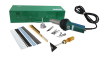
Feature Peudulum welding Draw welding Movement Swing the hot air nozzle side-to-side Feed rod through nozzle and pull backward Material Compatibility PP/PE/PVC/ABS PE/PP Only* Working Speed Medium High Welding Precision High control Smooth & consistent, depends on speed Required Accessories RiOn + Tubular Nozzle RiOn + Tubular Nozzle + Speed welding nozzle Best for Beginners, repairs, curved seams Professionals, production work, large surfaces
Why PVC Should NOT Be Draw Welded
Draw Welding uses higher heat and stronger airflow than Pendulum Welding suitable for PP/PE but disastrous for PVC.
PVC has:
- A stiff but brittle molecular structure
- Low tolerance to continuous high heat
- Chlorine fumes when overheated
- Unstable melt viscosity (can over-melt and create weak, porous beads)
If your job involves large PP/PE productssuch as pallets, water tanks, or industrial containersDraw Welding delivers better speed and efficiency.